
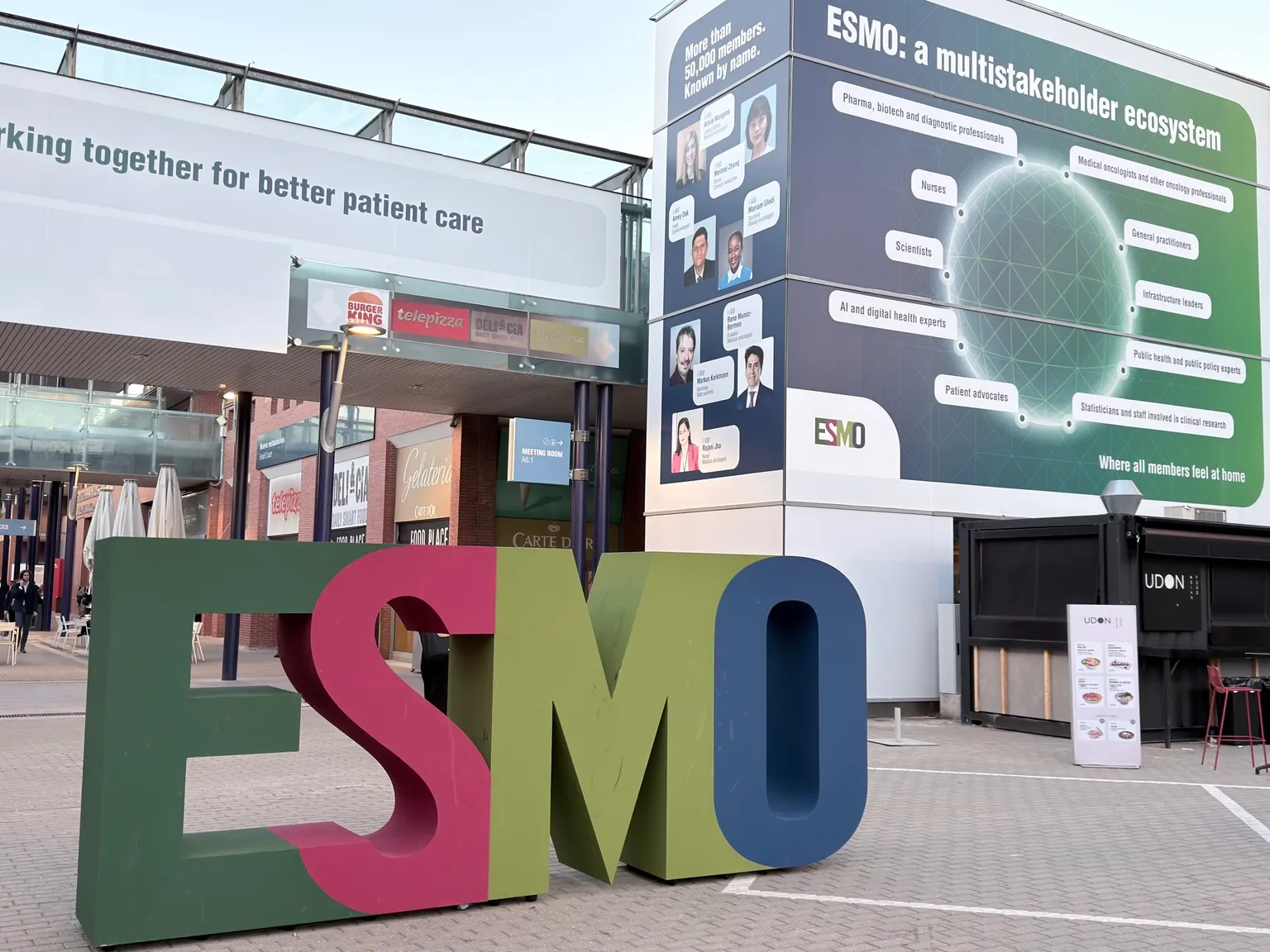
Madrid, 23–27 October 2026
The ESMO Congress 2026 brought together oncologists, researchers, healthcare professionals and patient advocates to discuss the latest advances in cancer treatment and care.
ALK Positive Belgium was represented at the congress, following scientific sessions on targeted therapies, cancer vaccines, treatment-related toxicities and emerging technologies, alongside discussions on access to treatment, health data, inequalities and patient involvement.
For people living with ALK-positive lung cancer, several themes stood out.
1. Longer disease control brings new responsibilities
Long-term findings from the phase III CROWN trial continue to demonstrate the substantial progress achieved with targeted therapies.
At seven years, the estimated progression-free survival rate was 55% among patients receiving first-line lorlatinib, compared with 3% with crizotinib. Median progression-free survival had not yet been reached in the lorlatinib group.
These results, first reported at ASCO 2026 and subsequently discussed at ESMO, represent an important development in the management of advanced ALK-positive lung cancer.
But longer disease control also changes the conversation about cancer care.
Patients may remain on treatment for many years, experiencing ongoing side effects and needing long-term monitoring and support. Managing treatment-related toxicities is therefore increasingly important.
2. Treatment tolerability matters as much as long-term efficacy
Sessions on managing novel therapies highlighted the importance of recognising and addressing treatment-related side effects early.
Lorlatinib can be associated with high cholesterol and triglycerides, oedema, weight gain, peripheral neuropathy, and cognitive or mood-related effects. These can affect everyday activities, work, relationships and quality of life.
In the seven-year CROWN analysis, approximately 34% of patients receiving lorlatinib required dose reductions.
Exploratory analyses did not identify worse progression-free survival among patients whose doses were reduced, although these findings do not establish that every dose reduction will preserve efficacy.
This supports an important principle: treatment should be actively managed to help patients remain on effective therapy while maintaining an acceptable quality of life.
Patients should feel able to discuss side effects openly with their oncology teams, including symptoms that may not appear particularly serious clinically but have a significant impact on daily living.
3. New ALK treatments are moving through development
Another important topic was the development of treatments designed to address resistance to existing ALK tyrosine kinase inhibitors.
Neladalkib, an investigational fourth-generation ALK inhibitor, has been designed to target ALK while limiting activity against certain other proteins, including TRK. Clinical data suggest a side-effect profile that differs from existing treatments, although liver enzyme elevations remain an important concern.
TRI-611 represents a different therapeutic approach. Rather than simply inhibiting ALK activity, it is designed to promote the degradation of the ALK fusion protein itself.
Preclinical findings have demonstrated activity against several ALK resistance mutations, including in models of intracranial disease. A phase I/II clinical study is now evaluating its safety, dosing and antitumour activity in patients.
These developments are encouraging, particularly for patients who develop resistance to currently available treatments.
4. Cancer vaccines: an emerging area worth following
Therapeutic cancer vaccines were another prominent topic at ESMO 2026.
Unlike vaccines designed to prevent infections, therapeutic cancer vaccines aim to stimulate immune responses against an existing cancer.
The ARCHER trial is investigating an ALK peptide vaccine designed to generate immune responses against common ALK resistance mutations. Early human results have demonstrated vaccine-induced T-cell responses in a majority of evaluable participants.
Other approaches under investigation include mRNA vaccines such as BNT116 in non-small-cell lung cancer, as well as personalised vaccines targeting tumour-specific neoantigens.
Positive phase III results with a personalised mRNA vaccine in melanoma provided an important development at ESMO. Nevertheless, these findings cannot automatically be extended to lung cancer or ALK-positive disease.
For ALK-positive lung cancer, the clinical value of therapeutic vaccination remains an open research question.
5. Quality of life must remain central to cancer care
Discussions on supportive care reinforced the importance of managing the broader effects of cancer and its treatment.
These include physical functioning, fatigue, metabolic changes, neurological symptoms and the long-term consequences of treatment.
Exercise, rehabilitation and other supportive interventions can play an important role, adapted to each patient’s medical circumstances and capabilities.
As more people live longer with advanced cancer, quality of life should not be considered secondary to disease control.
We need to understand not only how long treatments work, but also how patients live while receiving them.
6. Innovation must translate into equitable access
Scientific developments are meaningful only when patients can benefit from them.
Beyond the scientific sessions, ESMO addressed inequalities in cancer care, access to innovative therapies, the complexity of precision oncology and the ethical responsibilities surrounding clinical trials.
These issues are particularly relevant in molecularly defined cancers such as ALK-positive lung cancer, where timely molecular testing, access to specialist expertise and opportunities to participate in clinical trials can shape treatment options.
The discussions also highlighted the importance of planning what happens when a clinical trial ends, particularly for participants who continue to benefit from an investigational treatment.
The availability of innovative treatments should not depend solely on where a patient lives or which healthcare institution they attend.
7. Health data and meaningful patient involvement
Sessions on the European Health Data Space (EHDS) explored how health information could be accessed and responsibly reused to improve care, research and health policy across Europe.
For rare molecular subgroups such as ALK-positive lung cancer, connecting high-quality clinical and molecular data could help researchers better understand treatment outcomes, resistance and patients’ experiences beyond clinical trials.
But patient involvement must go beyond contributing data.
Patients and patient organisations should participate meaningfully in decisions about data governance, research priorities, transparency and how research findings are translated into improvements in care.
This requires early involvement, appropriate support and clear accountability for how patient contributions are considered.
Looking beyond ESMO 2026
The congress reinforced how rapidly oncology continues to evolve.
For ALK-positive lung cancer, long-term targeted therapy results provide genuine reasons for optimism, while new treatments and immunotherapy approaches offer important research opportunities.
At the same time, significant questions remain about resistance, treatment tolerability, long-term quality of life and equitable access to innovation.
ALK Positive Belgium will continue to follow these developments, share reliable information with the patient community and advocate for meaningful patient involvement in research and healthcare decisions.
Because progress in cancer treatment must also translate into progress in patients’ lives.